EKS extended support: what it costs and when to upgrade
EKS extended support raises the fee from $0.10 to $0.60 per cluster-hour. Costs for 1, 3 and 10 clusters, 2026–2027 deadlines, and when to upgrade.
- Author
- The Log’in Line team
- Published
- Topics
- KubernetesAWSFinOps
EKS extended support costs $0.60 per cluster per hour instead of $0.10: an extra $365 a month for every Amazon EKS cluster that runs a Kubernetes version more than 14 months old. AWS turns it on by default, so most teams find out from the bill. As of October 28, 2026, versions 1.31, 1.32 and 1.33 are billed at the extended rate, 1.34 joins them on December 2, and any cluster still on 1.31 after November 26 will be upgraded by AWS whether it is ready or not.
This page gives the numbers, the dates, and the rule we apply to the clusters we run when the choice is between paying and upgrading.
Prices and dates were read on the AWS, Google Cloud and Azure pages on October 28, 2026. Prices are in US dollars and cover the control plane fee only: nodes, load balancers and storage are billed separately and do not change.
What EKS extended support is and when a cluster enters it
On EKS, each Kubernetes minor version gets 14 months of standard support after its EKS release, then 12 months of extended support, so 26 months in total (AWS version lifecycle). What happens on the last day of standard support depends on one field, the cluster's upgrade policy.
With EXTENDED, the default for new and existing clusters, the cluster stays on its version and billing switches at 00:00 UTC on the end-of-standard-support date. With STANDARD, AWS upgrades the control plane to the next version instead. Check every cluster with AWS CLI v2:
aws eks describe-cluster --name <cluster-name> \
  --query "cluster.{version: version, policy: upgradePolicy.supportType}"
You can opt out, but only while the cluster still runs a version in standard support:
aws eks update-cluster-config --name <cluster-name> \
  --upgrade-policy supportType=STANDARD
Once a cluster is in extended support, that switch is locked until you upgrade it back into a standard version. The extra fee buys security patches for the control plane, patched VPC CNI, kube-proxy and CoreDNS add-ons, EKS-optimized AMIs for that version, and AWS support. It does nothing for your Helm charts, your ingress controller or your operators.
On the bill, look for the usage type ending in AmazonEKS-Hours:extendedSupport (prefixed with the region code, USE1- for N. Virginia) in Cost Explorer or in the Cost and Usage Report.
The calculation for 1, 3 and 10 clusters over 12 months
The headline “six times more expensive” is true of the control plane fee and of nothing else. The surcharge is a flat $0.50 per cluster-hour (EKS pricing), whatever the size of the cluster. A 3-node staging cluster pays the same extra as a 200-node production cluster.
With AWS's convention of 730 hours a month (8,760 a year):
| Clusters | 12 months on standard ($0.10/h) | 12 months on extended ($0.60/h) | Extra cost |
|---|---|---|---|
| 1 | $876 | $5,256 | $4,380 |
| 3 | $2,628 | $15,768 | $13,140 |
| 10 | $8,760 | $52,560 | $43,800 |
The common case is the 3-cluster row: production, staging, and a dev cluster, all built from the same Terraform module, all on the same version, all falling out of standard support on the same day. Rolling a cluster back to a version that is in extended support restarts the charges, too.
For scale, $365 a month is less than one day of a senior DevOps engineer in France. Our comparison with an in-house hire assumes €65,000 gross a year and about 45 % employer contributions; over 218 working days, that comes to roughly €430 a day. The fee alone rarely justifies a rushed upgrade. What it pays for is the real question.
The EKS extended support dates for 2026 and 2027
Dates from the AWS release calendar, in UTC:
| Version | End of standard support | End of extended support | Status on October 28, 2026 |
|---|---|---|---|
| 1.31 | November 26, 2025 | November 26, 2026 | Extended, forced upgrade in four weeks |
| 1.32 | March 23, 2026 | March 23, 2027 | Extended |
| 1.33 | July 29, 2026 | July 29, 2027 | Extended |
| 1.34 | December 2, 2026 | December 2, 2027 | Standard, extended from December 2 |
| 1.35 | March 27, 2027 | March 27, 2028 | Standard |
| 1.36 | August 2, 2027 | August 2, 2028 | Standard |
| 1.37 | December 1, 2027 | December 1, 2028 | Standard |
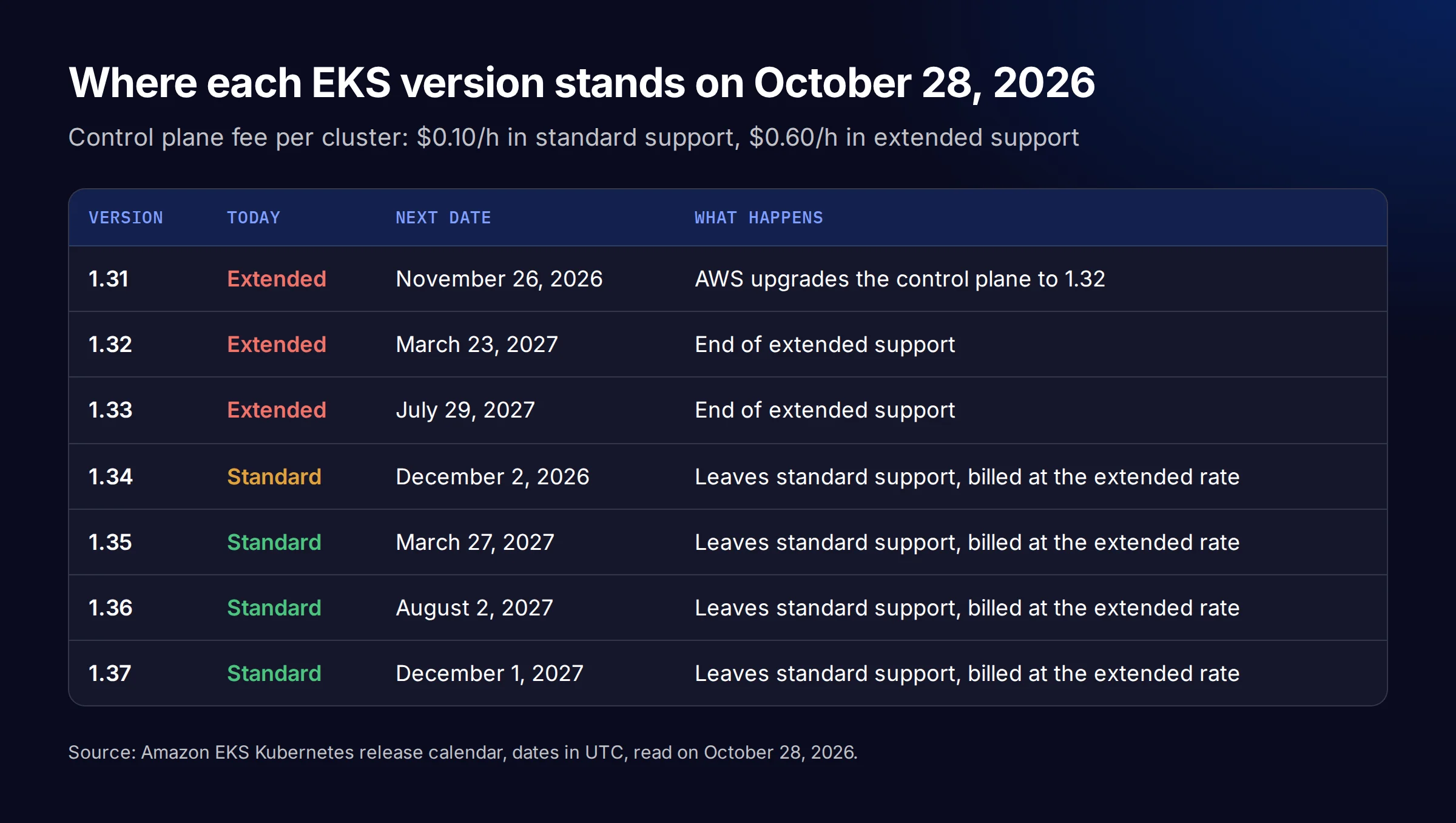
Two things follow. A cluster on 1.31 has no “pay and wait” option left: after November 26, AWS upgrades its control plane to 1.32 at a time it does not announce, and the managed node groups stay on 1.31. And upgrading to 1.34 this month buys five weeks of standard pricing. The first version that stays in standard support through spring 2027 is 1.35.
GKE and AKS charge the same fee on different terms
Google Cloud charges the same amounts in a different way. Every GKE cluster pays a $0.10 hourly management fee (a $74.40 monthly credit covers one zonal or Autopilot cluster per billing account). Clusters enrolled in the Extended release channel can stay on a minor version for up to 24 months and pay $0.50 more per hour only once that version leaves standard support (GKE pricing). Enrollment is a choice. At the end, GKE upgrades the cluster regardless of blocking issues.
Azure works differently. AKS gives about 12 months of community support per version; long-term support adds a second year, but only on the Premium tier, at $0.60 per cluster-hour against $0.10 for Standard (Azure retail price, West Europe). The Premium fee runs from the moment you switch tiers, not from the end of community support.
| EKS | GKE | AKS | |
|---|---|---|---|
| Extra support enabled by default | Yes | No (Extended channel) | No (Premium tier and LTS plan) |
| Total support per minor version | 26 months | Up to 24 months | About 24 months |
| Hourly price in the extra period | $0.60 | $0.60 | $0.60 (Premium) |
| Higher fee starts | End of standard support | End of standard support | When Premium is turned on |
| At the end | Control plane upgraded by AWS | Cluster upgraded by GKE | Upgraded after a 60-day grace period, from June 2027 |
EKS is the only one of the three that bills you for extra support you never asked for. That default is why the line shows up on bills nobody was watching.
Catching up several versions takes longer than you think
EKS upgrades one minor version at a time, and AWS asks that managed nodes run the control plane's version before the next step. Going from 1.31 to 1.35 is four control plane upgrades, four node rollouts and four rounds of add-on updates. Each step also brings its own breaking changes, listed in AWS's release notes:
- 1.31 to 1.32: the
flowcontrol.apiserver.k8s.io/v1beta3API is removed, and anonymous requests are refused everywhere except/healthz,/livezand/readyz. - 1.32 to 1.33: AWS stops publishing EKS-optimized Amazon Linux 2 AMIs. Nodes move to Amazon Linux 2023 or Bottlerocket, which means a new bootstrap (
nodeadmon AL2023) and rewritten launch templates. - 1.33 to 1.34: containerd 2.1 on the AMIs, and AppArmor is deprecated.
- 1.34 to 1.35: the kubelet refuses to start on cgroup v1 by default, and 1.35 is the last version that supports containerd 1.x.
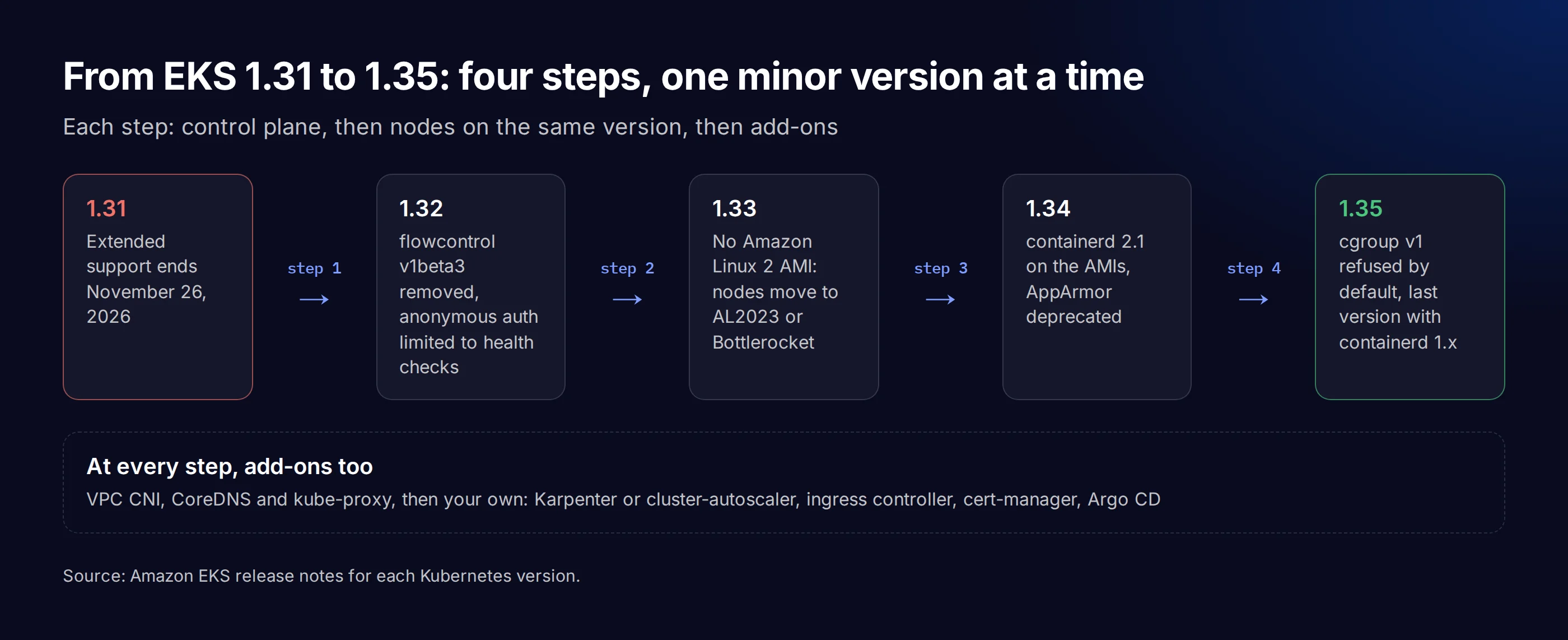
Then come your own components: Karpenter or cluster-autoscaler, the ingress controller, cert-manager, Argo CD, each with its own compatibility matrix. EKS upgrade insights flag deprecated API calls. They look at a rolling 30-day window and refresh every 24 hours. A fix you ship today can still show as a warning for weeks.
One thing lowers the risk: a cluster upgraded in place can be rolled back to its previous minor version within 7 days.
When to pay for EKS extended support and when to upgrade
Put both sides in the same unit. The extension costs clusters × months × $365. The upgrade costs steps × clusters × days per step × your day rate. Then apply four rules:
- One version behind, upgrade planned within the quarter: pay. Extended support exists so you don't upgrade production in a hurry.
- Two versions behind or more: the extension is not a plan. A new version ships every four months, the end date does not move, and a forced control plane upgrade with nodes three versions behind is the worst place to be.
- Staging and dev: set them to
STANDARDwhile they are still on a standard version. AWS upgrades them first, and they become your warning for production. - Clusters you will delete or rebuild within a few months: pay and leave them alone.
A worked example, with an assumption you should replace with your own: three clusters on 1.32, and two days of work per step and per cluster, tests included. Paying until March 23, 2027 (five months) costs 3 × 5 × $365 = $5,475. Upgrading now means three steps to reach 1.35, so 18 days, including the move off Amazon Linux 2. Waiting until March does not remove those 18 days. By then 1.35 leaves standard support on March 27, the target becomes 1.36, and the job grows to four steps, 24 days by the same assumption. The extension postpones the work and adds to it.
If the extendedSupport line is already on your bill, our AWS managed services include those upgrades every quarter, and a cloud bill audit will show how many clusters it applies to. Or tell us which versions you run and we will help you size the catch-up.
FAQ
How much does EKS extended support cost?
$0.60 per cluster per hour, against $0.10 in standard support: $0.50 more, or about $365 a month and $4,380 a year per cluster. The fee is the same for every cluster, whatever its size. Nodes, storage and network are billed as before. The higher rate starts at 00:00 UTC on the version's end-of-standard-support date.
Can I disable EKS extended support?
Yes, with aws eks update-cluster-config --upgrade-policy supportType=STANDARD, but only while the cluster runs a version still in standard support. Once it has entered extended support, the setting is locked: upgrading to a standard version is the only way to stop the charges. With STANDARD, AWS upgrades the control plane itself when standard support ends.
What happens when EKS standard support ends?
With the default EXTENDED policy, nothing visible: the cluster keeps its version and the hourly fee goes from $0.10 to $0.60. With STANDARD, AWS upgrades the control plane to the next version. In both cases, nodes and add-ons are not upgraded for you, and after 26 months AWS upgrades the control plane anyway.
About the author
The Log’in Line team