10 Kubernetes Trends That Will Redefine Cloud Computing in 2026
April 1, 2026

Key Takeaways:
- Kubernetes adoption is expected to reach new heights, becoming the absolute standard for 80% of enterprises.
- Artificial Intelligence and Machine Learning are the new primary drivers of K8s deployments.
- Platform Engineering is replacing traditional DevOps to reduce the cognitive load on developers.
- Edge Computing and the rise of WebAssembly are opening entirely new frontiers for decentralized orchestration.
The Evolving Cloud Landscape
Cloud Computing is going through a fascinating phase of maturity. Kubernetes, which recently celebrated its tenth anniversary, is no longer an experimental open source project reserved for a handful of experts. It has become the backbone of global digital infrastructure. In 2026, the question is no longer whether you should use Kubernetes, but how to optimize it for extreme new use cases through a managed Kubernetes service.
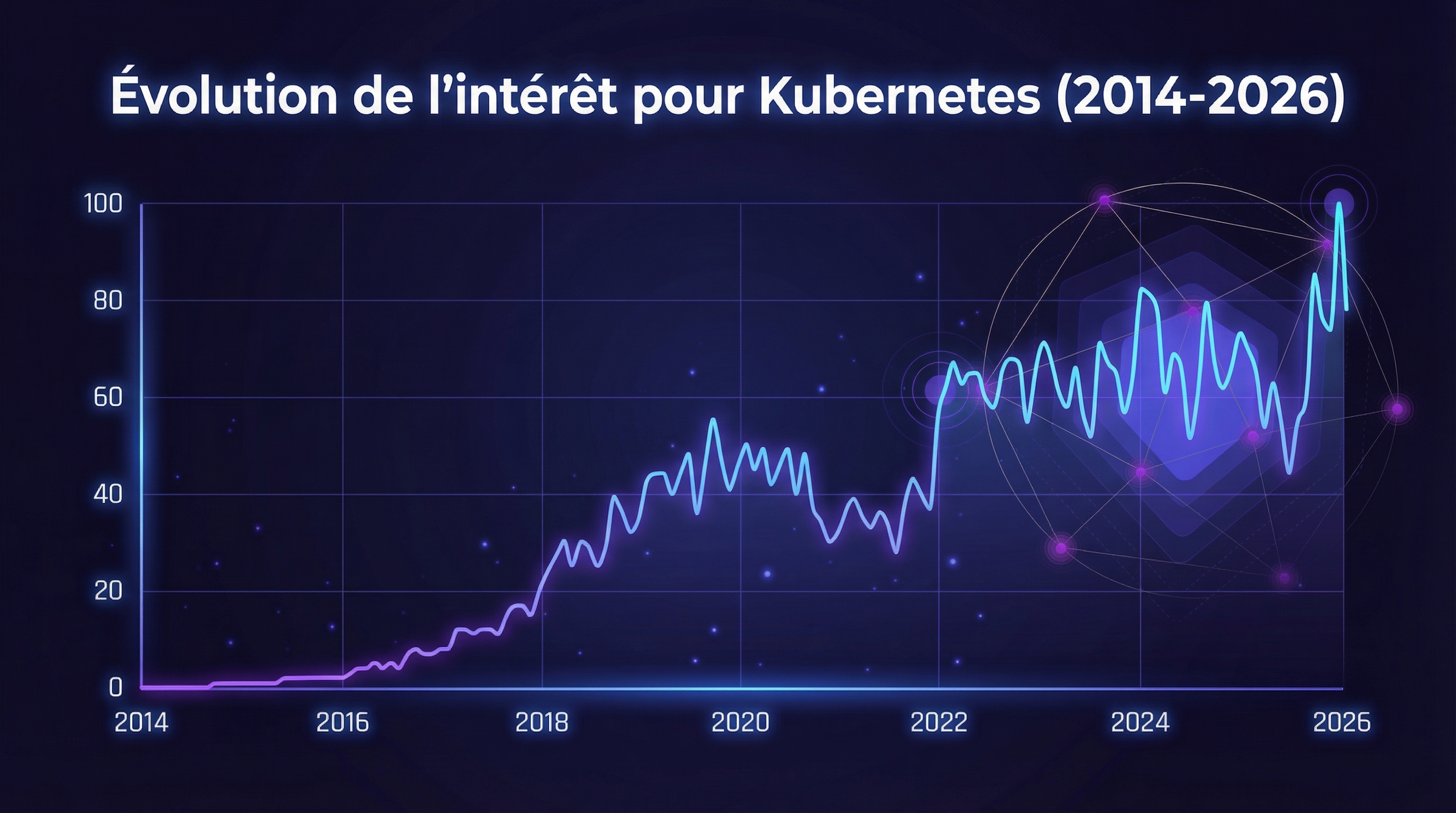
The Challenges of Complexity
Despite its power, the orchestrator brings undeniable complexity. Platform engineering teams must juggle security, exploding costs, and sprawling distributed architectures. The 2026 trends are a direct response to these challenges: simplifying the experience, securing by default, and mastering budgets.
As we look ahead to 2026, the cloud-native ecosystem is undergoing an unprecedented transformation. The era of simple stateless web applications is giving way to an age dominated by artificial intelligence, massive decentralization, and cognitive automation. To address the complexity challenges mentioned above, organizations must embrace new paradigms. Here is an in-depth analysis of the 10 major trends currently reshaping the contours of orchestration and Cloud Computing.
1. Artificial Intelligence and Machine Learning at the Heart of Clusters
One of the most colossal trends for 2026 is undeniably the fusion between Kubernetes and Artificial Intelligence. Today, we no longer simply deploy microservices; we orchestrate deep learning models and complex data pipelines. It's remarkable to note that 90% of users expect their AI and Machine Learning workloads to grow on Kubernetes.
Why such enthusiasm? Because AI needs flexibility and on-demand power. Kubernetes excels in this domain by managing dynamic GPU resource allocation, which is vital for training LLM models without burning money.
- Intelligent GPU allocation: K8s assigns computing power exactly where the model needs it, avoiding hardware under-utilization.
- Horizontal scalability: Perfect for handling traffic spikes during model inference in production, scaling from 1 to 1000 pods in a flash.
- Resilience: Self-healing capabilities ensure your data pipelines never interrupt mid-computation.
In 2026, Kubernetes is no longer just a container orchestrator — it has become the default operating system for Artificial Intelligence.
2. The Inevitable Rise of Platform Engineering
Goodbye to traditional DevOps where every developer had to juggle dozens of complex infrastructure tools. Welcome to Platform Engineering! The growing complexity of Kubernetes has pushed enterprises to create "Internal Developer Platforms" (IDPs). The goal is simple: hide the complexity under the hood and offer developers an intuitive self-service portal.
In 2026, it is estimated that 80% of organizations will have adopted this approach, up from just 45% a few years earlier. The idea is not to restrict developers, but to drastically reduce their cognitive load.
- Automation of standards: Platform engineering teams pre-configure environments with built-in security best practices.
- Massive time savings: No more IT support tickets to get a test cluster — everything is automated.
- Centralization: Developers can finally focus on what they love: writing quality code, while the platform handles the plumbing.
This trend is a lifesaver for companies that struggled to find K8s experts in the job market.
3. FinOps and GreenOps: Optimization Takes Center Stage
The era of growth-at-all-costs where servers were provisioned without checking the bill is over. Cloud waste easily exceeds $21 billion per year. In 2026, FinOps (Financial Operations) is seamlessly integrated into Kubernetes workflows. Companies want to know exactly which microservice or team is consuming the budget so they can take concrete actions to reduce Kubernetes cluster costs.
At the same time, GreenOps is gaining momentum. Tracking costs is good, but tracking carbon footprint has become a strategic and regulatory obligation for large enterprises. We are starting to see carbon-aware autoscalers capable of shifting workloads to geographic regions powered by renewable energy.
To give you a clearer picture of the tools dominating this space, here is a FinOps tools comparison between Kubecost and OpenCost.
| Feature | OpenCost | Kubecost |
|---|---|---|
| Model & License | Open source project (CNCF) | Commercial product (based on OpenCost) |
| Key features | Basic cost calculation (CPU, RAM, GPU) | Advanced governance, alerts, recommendations |
| Ideal audience | Small teams, very limited budgets | Large enterprises, complex multi-cloud environments |
Adopting these tools enables a shift from a reactive posture to proactive, intelligent cloud budget management.
4. The Frontier Expansion to Edge Computing
Edge Computing brings computing power closer to where data is generated (factories, autonomous vehicles, stores). With forecasts indicating that 75% of enterprise data will be processed "at the edge", Kubernetes had to undergo a serious diet to adapt.
Classic heavyweight distributions don't work on a small IoT sensor or a poorly ventilated supermarket server. This is where ultra-lightweight distributions shine in 2026. These stripped-down versions require very little RAM and CPU while preserving the declarative magic of K8s.
| Distribution | Main Maintainer | Specifics and Use Cases |
|---|---|---|
| K3s | Rancher (SUSE) | Ideal for IoT, replaces etcd with SQLite, extremely lightweight |
| MicroK8s | Canonical | Perfect for Ubuntu ecosystems, simple installation via Snap |
| K0s | Mirantis | Security-focused (100% FIPS), single binary easy to distribute |
As highlighted in this comparison of lightweight K8s implementations, whether K3s or K0s, these tools enable managing thousands of distributed clusters around the globe from a single central control point.
5. The Quiet Revolution of Serverless Kubernetes
Combining the words "Serverless" and "Kubernetes" may seem paradoxical. After all, K8s is famous for its precise management of nodes and underlying infrastructure. Yet in 2026, Serverless Kubernetes has established itself as an obvious choice. Developers simply want to deploy their code without ever having to configure a single Worker Node.
Technologies like Knative or OpenFaaS, combined with managed offerings from cloud providers, allow running ephemeral functions directly on a cluster.
- Scale-to-zero: If your application receives no traffic, it consumes absolutely no resources. It's magic for the wallet.
- Pay for actual usage: Moving away from the paradigm where you pay for servers that sleep at night.
- Ideal for AI: Model inference accommodates this elastic architecture perfectly.
This is a boon for startups that want the power of K8s without hiring an army of system administrators.
6. "Zero Trust" Security and the eBPF Revolution
Cloud-native security is no longer an afterthought. Faced with an explosion of cyberattacks and complex vulnerabilities, enterprises in 2026 are massively adopting "Zero Trust" architectures (trust no one, verify continuously).
But the real technical star of this reimagined security is eBPF (Extended Berkeley Packet Filter). Simply put, this technology allows running very fast, isolated security programs directly in the Linux kernel, without having to modify the kernel source code or add heavy modules.
Until now, monitoring traffic in K8s relied on "sidecars" (additional containers grafted onto each application), which slowed everything down. eBPF eliminates this need. It provides instant visibility, allows blocking suspicious behavior in real-time, and dramatically improves network performance. It's a monumental advance for securing clusters without sacrificing developer velocity.
7. Multi-Cluster Management and the "Noisy Neighbor" Problem
Gone are the days when a company put all its eggs in one basket with a gigantic monolithic cluster. In 2026, the standard is multi-cluster and hybrid cloud deployment. Why? Mainly for resilience and legal compliance reasons (data sovereignty) and to avoid the "noisy neighbor" syndrome.
Imagine a resource-hungry application monopolizing all cluster resources, causing other critical applications nearby to crash. By isolating workloads in separate clusters by department or geographic zone, this risk is eliminated.
Fleet management tools like Azure Arc or Rancher allow supervising dozens, even hundreds of clusters spread across AWS, Google Cloud, and your own local datacenters, all from a single dashboard with a unified API. It's the ultimate guarantee against vendor lock-in.
8. GitOps Becomes the Absolute Standard
Deploying manually or via old obscure scripts? That's ancient history. In 2026, GitOps is the reigning method for managing Kubernetes. The concept has a rare elegance, building on Infrastructure as Code principles: your Git repository (like GitHub or GitLab) becomes the one and only source of truth for your infrastructure.
Concretely, tools like ArgoCD or Flux continuously monitor your Git repository. If an engineer modifies a configuration file to add a server, the tool detects the change and applies it instantly to the cluster, ensuring perfect auditability and effective fight against "Drift".
- Perfect auditability: We know exactly who changed what and when.
- Immediate rollback: If a deployment breaks, simply reverting the commit (git revert) brings the cluster back to its previous healthy state.
- Fighting "Drift": If someone secretly modifies the cluster manually, the GitOps system will override it to force a return to the state described in Git.
This approach brings incredible peace of mind to operational teams.
9. The Growing Integration of WebAssembly (Wasm)
If you haven't yet heard about WebAssembly (Wasm) in the cloud context, hold on tight. Originally created to run high-performance code in web browsers, Wasm is disrupting the Kubernetes ecosystem in 2026.
Note that Wasm won't replace traditional Docker containers — it's establishing itself as a formidable partner instead. A WebAssembly module is incredibly lighter and more secure than a classic Linux container. It starts in milliseconds, where a heavy container can take several seconds.
For Serverless or Edge Computing use cases (where bandwidth and memory are limited), deploying Wasm modules orchestrated by Kubernetes has become an ultra-performant practice. This enables lightning-fast response times while retaining the familiar ecosystem and API of K8s.
10. Stateful Workloads and the Unification with Virtual Machines
Historically, Kubernetes was designed for "stateless" applications — those that retain no persistent data. Databases had to remain safely outside the cluster on dedicated virtual machines (VMs). In 2026, this dogma has fallen.
The maturity of storage interfaces (CSI) now allows enterprises to run heavy databases or caching systems directly in K8s with full confidence. Even more striking: the boundary between containers and virtual machines is disappearing.
Innovative projects like KubeVirt allow managing existing VMs exactly as if they were Kubernetes pods. For an enterprise adopting cloud-native migration strategies for its old monolithic applications, this is the absolute Holy Grail. Infrastructure is unified, third-party licensing costs are reduced, and all IT is managed from a single interface.
Conclusion
The year 2026 marks a definitive turning point for Kubernetes. It's no longer simply about orchestrating small web containers. K8s has become a universal, intelligent, and highly distributed infrastructure platform.
The infusion of Artificial Intelligence is fundamentally changing how resources are allocated, while Edge Computing is pushing the technology beyond traditional datacenters. At the same time, Platform Engineering and practices like GitOps and FinOps are rationalizing the daily work of technical teams. They hide complexity, secure deployments, and optimize ever-tighter cloud budgets.
If you manage modern IT projects, understanding and adopting these ten trends is no longer a luxury option — it's a matter of technological survival. Kubernetes has grown up, and it's high time to update your strategies to harness this rapid evolution.

Anthony Marchand
Co-founder @ Log'in Line
Tech entrepreneur for 10 years & cards lover ♥️♣️♦️♠️
LinkedIn